
Cards
Why are Willie Mays cards undervalued compared to vintage gems of Mickey Mantle?
The baseball careers of Mickey Mantle and Willie Mays mirror each other closely.
Mantle made his MLB debut with the New York Yankees just 5½ weeks before Mays was called up by the New York Giants in 1951.
Related Content:
Mantle played 18 seasons, was a 20-time All-Star—when MLB held two All-Star games per season from 1959-62—a seven-time World Series champion and three-time American League MVP. Mays played 23 seasons, was a 24-time All-Star, won one World Series and was named the National League MVP twice. Both rank in the top 20 on the all-time home run list.
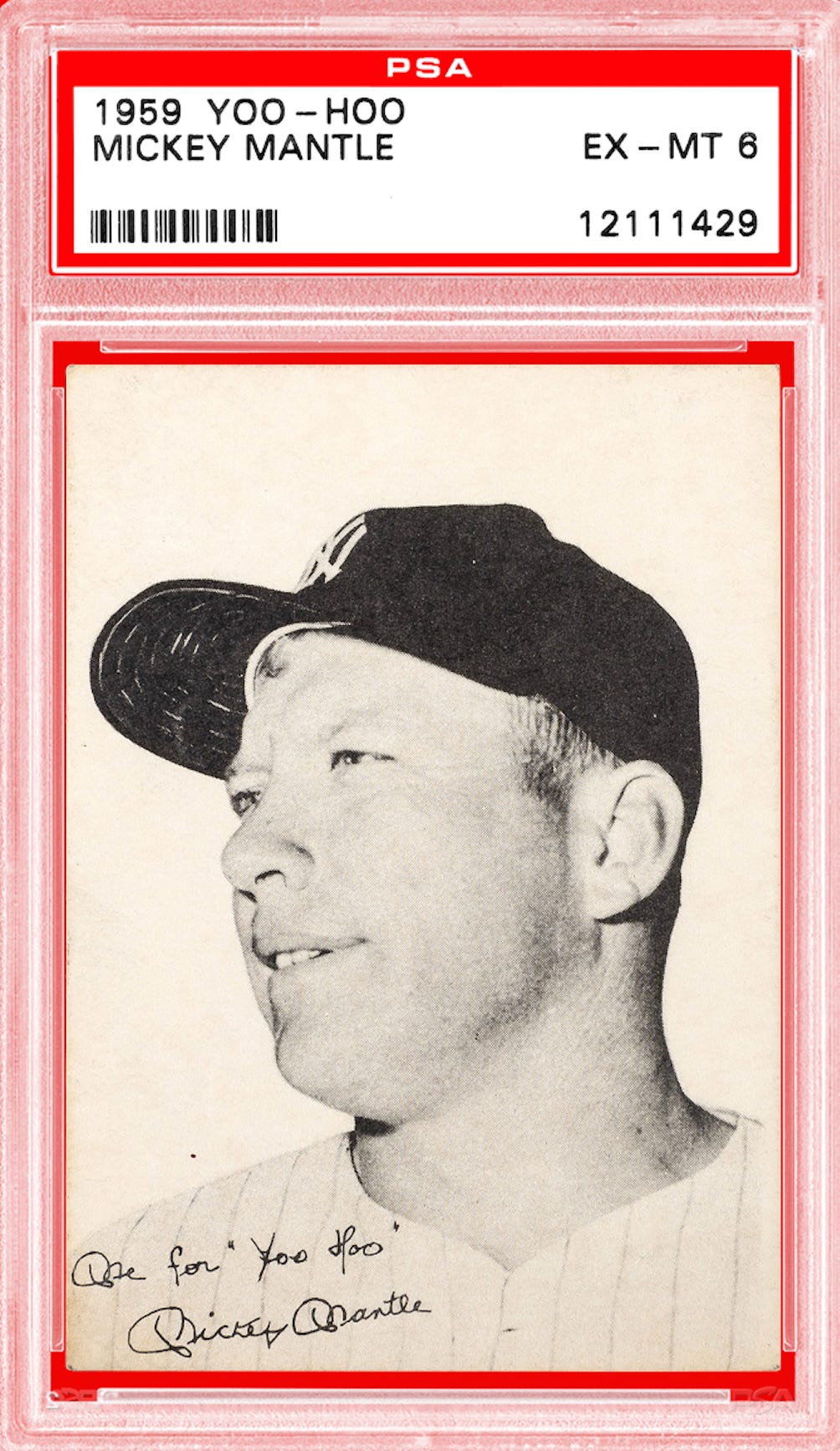
Mantle and Mays are two of the greatest baseball players of all time. But despite all their career similarities, card and memorabilia prices for the two legends reflect a stark contrast. The value of Mays cards pale in comparison to Mantle.
Take the 1951 Bowman product for example. It’s the true rookie card for both Mantle and Mays. As of the end of February, PSA had graded just under 2,900 Mantle copies, with only one receiving a 10—which is in the collection of Arizona Diamondbacks owner Ken Kendrick. For Mays cards, PSA had graded just shy of 2,500 without a single 10.
Mantle cards in a PSA 2-3 range in price from $14,000-$20,000. However, Mays card in those same grades sell for between $4,000-$7,000. Different factors like eye appeal and centering can produce outliers to those prices. As the grades get higher, the price difference between Mantle and Mays gains more and more separation.
It’s a similar case for each players’ 1952 Topps card—with Mantle’s card even more inflated than Mays. Yes, that iconic Mantle card, which sold for a then-record $12.6 million in 2022, hits differently for a number of reasons.
However, this begs the question: Is Mays undervalued in the hobby?
MAYS UNDERVALUED
Vintage card experts and collectors that SCD spoke with all agree there is quite a discrepancy in prices between the two stars.
“I’ve been saying that for several years as we’ve watched the Mantle prices just continue to climb and climb and climb,” REA President Brian Dwyer said. “Mays also increases, but in my experience not as dramatically and they haven’t reached the highest points like Mantle has despite all these similarities in their card issues and years.”
Renowned collector Marshall Fogel added: “I think Willie Mays is undervalued, but he’s not cheap.
“Do I think Mays has earned his spot as one of the top cards you want to collect? Oh, absolutely. He may not be where Mantle is, but he’s a player that if you can get a card in high grade, you’re going to pay a lot of money.”
Memory Lane Inc. founder JP Cohen has handled some of the best Mantle and Mays cards over the last 25 years. He wholeheartedly believes Mays cards aren’t valued in the hobby as highly as they should be.
“You would think being who he was and what a great player he was, his cards should be up there with Mantle, but they’re not. There’s significantly a big discrepancy in value, for the most part,” Cohen said. “When you compare him to the ’51 Mantle or the ’52 Mantle—the ’52’s a little different, but it’s usually like a 60/40 kind of thing.”
The ’51 Bowman Mantle card has shot up in price significantly over the last five years. It seems that collectors have really latched onto the fact that it’s Mantle’s true rookie card, and not just his first Topps card, which came out the following year.
“In my experience, it seems like the purest collectors always preferred ’51 Bowman over ’52 Topps—first mainstream Mantle. That’s what they considered his true rookie card,” Dwyer said. “You’ve got a lot of people that just said, ‘I’m only a Topps collector,’ [and] that gravitated towards the ’52. Mantle has always been more valuable than Mays in my experience, but it wasn’t as wide of a gap as it is now.
“I think in that 2018, 2020 era probably, they really started to see some separation. If you look at the population of ’51 Bowman, both of them are very scarce in high grade, but Mantle cards it seems come up for sale a little bit more regularly than Mays. I think availability probably also contributed to it spiking in price. There was just more opportunity for more people to get involved, and I think that continued to build the momentum that we’re seeing here in 2026.”
As for the 1952 Topps cards for both players, as of the end of February, PSA had graded just under 2,100 Mantle examples with only three being awarded perfect 10s. Mays, on the other hand, had just shy of 3,300 graded PSA cards with one reaching a 10.
It’s been widely publicized over the years that the Mantle card has such a low population due to the fact that his card appeared in the high series for 1952 Topps. Also, it’s unknown how many copies Topps dumped into the Hudson River to clear out room for its next product.
These days Mantle cards even graded PSA Authentic fetch $35,000-$40,000. In PSA 2 and 3 slabs, that card is selling for upwards of $75,000. A PSA 8—with a population of 35—sold recently in a private transaction for $1.1 million. Mays cards from the 1952 Topps release in PSA 2 and 3 go for between $3,500-$7,000.
“Why do I think it hasn’t caught up in value? I think the hobby founding fathers are kind of to blame there,” Dwyer said. “They held Mantle out, and I think rightfully so, as that premium card of the ’52 Topps set. It just had so much going for it. Even though stylistically the two cards are similar, Mantle kicks off that high-number series, New York Yankee, great player and kind of had a lot of different ingredients going for it and subsequently became the face of the trading card hobby.”
Over the last decade, the 1952 Topps Mantle has shot up in value. Remarkably, at the National Sports Collectors Convention in 2015, ’52 Topps Mantles in a PSA 1 were priced between $5,500-$11,000 at dealers tables. Oh, how times have changed.
“The Mantle is the holy grail post-war card,” Cohen said. “It’s an iconic card that kind of took on a notoriety of its own. People have collected it and given it a lot of popularity. Maybe it was because all the World Series around that time that the Yankees won or were involved in. But you would think Mays should be pretty close and second fiddle there.”
At just a few thousand dollars, a ’52 Topps Mays in even a low grade such as a PSA 2 isn’t going to drain a collector’s bank account. That’s certainly one good aspect for potential buyers.
“I love that it’s still affordable, because it means that a lot of people can still get it for their collection,” Dwyer said. “I have not been in the hobby as long as many others, but I’ve been in the hobby for 20 years in a professional level, Mays cards in PSA 2 used to be under $1,000. It’s intriguing to see how prices all across the board have ticked upward but it’s nice that some of the lower grades haven’t gotten entirely out of reach for some larger groups of collectors.”
THE DISCREPANCY
There are many theories as to why Mays’ cards aren’t as valuable as Mantles.
One main factor Fogel believes is because of geographic reasons. Mantle played in New York where baseball was king. Mays spent the first six years of his career in New York before the Giants moved to San Francisco in 1958.
“If you look at Mays’ cards, anything he had to do with San Francisco goes down in value,” Fogel said. “You collect him because he was a New York Giant. Another thing is, Mantle played his whole career with the Yankees. I’m a great believer, if you play your whole career and you become a Hall of Famer with one team, that’s a good deal.”
Fogel—who owns the nicest PSA 10 copy of Mantle’s 1952 Topps cards—thinks another reason for the price discrepancy relates to the types of careers each player had and historical moments they played a part in.
“I think during his career the only thing you really remember about Willie Mays is the catch in 1954,” Fogel said. “Where with Mantle, there’s so many things you remember: 16 home runs in World Series play, Triple Crown, his relationship with Stengel and his relationship with DiMaggio. There’s so much to him. Plus, he’s a superstar.”
Mantle also carries an underdog story where he had to fight through a tough childhood to make his big league dream a reality.
“If you’re a high-end collector, you’ve got to have Willie Mays. He may not be Mantle, but there’s good reason why he’s not,” Fogel said. “I don’t know much about Mays as a kid. But Mantle was abused by a relative, he almost lost his leg from [osteomyelitis], his father died at 40, and he’s with the New York Yankees at 19. Mays does not have that story.”
According to Cohen, Mantle’s connection to the storied Yankees franchise helps boost his cards a number of notches.
“A lot of Yankee fans, a lot of the early collectors in our hobby, if you would do a questionnaire in the ’80s, ’90s, there were so many more Yankee fan collectors, so maybe that was a driving factor,” Cohen said. “Collecting was very hot in the ’50s and ’60s and Mantle with all the World Series was very successful, making him more popular than Mays. But from a player-to-player standpoint, you would think Mays should be pretty close to Mantle when it comes to notoriety.”
COLLECTING MAYS
Paul Hersey started collecting Mays cards in third grade. He stopped for a short time, but the 71-year-old collector has been continuously going after his favorite player for the last 40 years.
“I grew up in the Bay Area, so, obviously, a Giants fan,” Hersey said. “My uncle used to take us to games—probably five, six games that I can remember—as a kid. That’s all it took.”
Hersey, who owns the third current finest Willie Mays Master Set on the PSA Set Registry with a GPA Weighted score of 5.98, has roughly 600 Mays cards in his collection.
Hersey doesn’t collect Mays cards because of their value. There is a sentimental piece attached. However, it doesn’t hurt that his cards are worth money. But the longtime collector does think Mays cards are undervalued.
“Card collecting is about supply and demand for value,” Hersey said. “There were fairly similar amounts of Mays to Mantle cards. There wasn’t that much difference, I would think. Some years there might be, but, overall, where the demand comes from is where there’s three times as many people that want Mantle cards as Mays cards. It’s all East Coast driven, and the East Coast has three times more people than the West Coast. That’s driven demand. It used to drive me crazy, because you’d think they were just as popular, just as good. Well, they were, just in different areas. Mentally, I would say, how come Mays cards are going up? Mantle’s going up.”
Hersey thought that when Mays died in 2024 at age 93, his cards might take a bump, but they didn’t. Mantle died in 1995 at age 63. Mays lived 30 years longer and his items are more readily available due to that fact.
“He signed cards like crazy and memorabilia, so his signatures are out there a lot, so I don’t think that changed much with his death,” Hersey said. “Where Mantle, I think it did. I don’t think he signed as much. And if he did sign as much, there are three times as many people that want his signature.”
Hersey’s most valuable Mays card is his 1951 Bowman. He has it in a PSA 6 slab, which is in the $25,000-$30,000 price range.
“I would like an 8,” Hersey joked. “But I think that’s just another six figures just to get an 8.”
Hersey also owns a 1952 Topps Mays in a PSA 5 and a ’52 Berk Ross in a PSA 8, which are both valued at around $15,000.
ROOM TO GROW
Cohen believes Mays cards should close the gap on Mantles as more and more collectors dive into the history of the game and its significant players. A lot of longtime collectors that have carried the hobby watched the likes of Mantle and Mays and saw their impact on the sport.
“The demographic of the collecting world out there for a long time is somebody in their 40s or 80 years old, not young generations. That group of collectors saw these guys play and a lot of them were Yankee fans, so that’s probably what made Mantle so popular and so liked because he was part of the Yankees—it’s a likeable team,” said Cohen, who believes Mays’ most undervalued card is his 1952 Topps.
“As years go on here, if you’re going to be a collector of vintage stuff, the majority of people, if not all of them, eventually will say, ‘I never saw Mantle play. I never saw Mays play.’ Maybe that will give people a desire based on the history of who the player was and what a great player he was, not so much the personal connection to them.”
Over the next five to 10 years, Dwyer expects the value of Mays cards to steadily climb. There is still plenty of room to grow for the Say Hey Kid.
“I don’t think at this point in time we’re going to wake up one day and see Mays cards be on par with Mantle cards,” Dwyer said. “I think the hobby has spoken to a certain extent. I think there’s been ample opportunity for people to kind of evaluate the populations and the availability and all that and they’ve chosen Mantle as their primary guy when it comes to card collecting.
“That being said, I do think there’s more room to run for Mays and he may excel at a quicker pace than Mantle, but I don’t think it’s going to be off the charts growth in Mays cards. I think it will just continue to appreciate as vintage cards generally have.”
You Also Might Like: